Showing posts with label hockey. Show all posts

Friday, January 15, 2016

Listen to Hockey Talk Radio

As a convenience to my many Hockey Diary visitors, I've placed a player here so that you might listen to Hockey Talk Radio.  All you need to do is click on the arrow on the player down below to hear that station in progress -- with lots of advice packed shows and fan-based NHL podcasts.
* 
-- Dennis Chighisola

Listen to Hockey Talk Radio

Listen to Hockey Talk RadioAgain, this page has been created to give members and passersby a chance to listen to Hockey Talk Radio. For sure, you can always come here if it suits your needs -- you get to hear the station exactly like it airs from our dedicate site. However, I highly recommend two other methods.
- Many of our fans listen to Hockey Talk Radio from a special site at hockeytalkradio.us. There can be found profiles for all our hockey podcasters, a special area for Hockey Talk Radio NEWS, a highlighted "Show of the Week" -- which includes a sample show, and much, much more.
Listen to Hockey Talk Radio- Still, I'm sure a great many listeners access Hockey Talk Radio on-the-go, or with their smartphones.  I do that often, myself, as I walk my little cockerpoo several times per day and night.  Using the Radionomy app is really easy, and -- using the instructions on a special page about that, it's also easy to download and install on any kind of phone.
*
Again, the Hockey Talk Radio website contains a ton of information and help, and it also provides ways listeners can become actively involved with the station. You can ask questions or add comments at the bottom of each show host's page, you can suggest to me ways I might improve the station, and there's even quite a bit of information about creating your own podcast and joining our all-star podcast lineup.
*
So, please listen to Hockey Talk Radio any way you'd like -- either from the main website, from your phone, or by pressing the arrow down below.  And, enjoy...
--------------------------------------------------

Wednesday, March 11, 2015

Whole Body Vibration

Anyone who knows me knows that I'm a workaholic.  Truth be known, though, I love what I do -- researching and writing, researching and creating new hockey training methods.  Still, I firmly believe that it's possible to get tons of work done, while also enjoying life.  And, while that might be a whole 'nother subject for another day, let me just say that Brenda and I try to fit at least a few minutes of active relaxation into each day -- a couple of times per day.

With that, we decided to take a few minutes today to sit at poolside.  On the way, I happened to grab a free newspaper-like publication at the clubhouse for something to browse while catching some sun.  That publication, called "Lifestyles", is aimed at keeping the local senior set up on activities, but it also carries a number of articles on health issues.  And, while thumbing through, something jumped off one page and caused me to start reading aloud to Brenda, opening with, "Get a load of this..."

Within a few sentences, we both recognized the article's description of a gadget called the "LivMD" as something we've used quite a bit.  "The application of LivMD is known to aid microcirculation in muscles, to stimulate stem cell activity, to facilitate healthy muscles and bones, and to encourage lean body mass over adipose tissue."  Yup, what it was describing was something I've owned for a number years, that being a (Soloflex) "whole body vibration" machine.

Now, it's probably been about a dozen years since I first learned about something also referred to as "WBV".  Actually, I can't even remember how I happened upon such a process, or such a device.  A lot of research did bring me to some pretty interesting background information, though...

One website traces WBV to the old Soviets... "The world first caught a glimpse of the results of Whole Body Vibrational-training when the Russians began to win most of the Gold Medals at the 1960 Olympic Games. Next, they found they could keep their cosmonauts in space for an extended period. Soon it was over a year longer than the United States could. The Soviets kept the technology of whole body vibration a secret until after the Berlin Wall came down in November 1989.  In fact, it took over 30 years for the rest of the world to discover the secret to Russia's Olympic and outer-space achievements."   

Yet another website states that "A new treatment under study by NASA-funded doctors could reverse bone loss experienced by astronauts in space."  And, of course, they're talking about Whole Body Vibration.  (I just completed a podcast that will include an audio presentation from Science at NASA, and you can hear that as "Episode 23 - Whole Body Vibration for Strength Gains" on my podcast sit.)

I could go on about the scientific literature here.  However, here's the Conclusion from one scientific study...
"The use of vibrations in an athletic setting offers new possibilities to coaching science. Resistance training effectiveness has been demonstrated due to the possibility of enhancing neuromuscular performance, power output. strength and hormonal profile. However. the time needed for these adaptations to occur is relatively long as compared to the possibilities offered by vibration treatments. It should be recognised however, that vibrations need to be viewed not as a substitute tool of resistance exercise but as a valid additional means to be implemented in a training routine in association with all the other traditional methodologies nowadays utilised. New studies need to be conducted to analyse chronic responses. different treatment protocols and the effects of the association of vibrations with conventional training means for improving the knowledge in this interesting and exciting tool of sports science."
Now, here's my unscientific impression, based on a ton of reading over the years, and the main reason I purchased my own WBV machine...  It's my understanding that whole body vibration recruits far more cells than a traditional exercise, and that those cells go through far more actions because of the vibrations.  Consequently, I've read that a few minutes of whole body vibration work can produce results that normally would take numerous reps and sets with heavy resistance.

Today, whole body vibration technology is being utilized for health and fitness, recovery and rehab, sports performance and anti-aging puproses, on a Global scale.  Everyone from the elderly, the person with physical disabilities, to the general person looking to get toned and healthy is using this form of exercise.

Lastly, I've brought this interesting method of training to light mostly as an FYI.  As you might know by now, I tend to drift into areas of science that few other hockey coaches would even know about.  As a matter of fact, I wrote the following article (to include three unbelievable videos) for CoachChic.com ages ago:  "Whole Body Vibration Strength Training".

Wednesday, January 28, 2015

3 Steps to Hitting Your Goals Every Time

By now, I suspect my readers know I subscribe to a lot of different newsletters -- from my favorite game of hockey to scientific studies to motivational stuff to Internet marketing.  I think such variety keeps me going and growing, and it might even prevent me from being tooooo boring.
With that, a newsletter came in the other day that I just knew I had to share with you.  It was from one of my earliest Internet marketing gurus, a guy name Jim Edwards, from Port Haywood, Virginia.  Besides the fact that he's a sharp cookie, I think I also like Jim because of his down to earth ways, maybe owing to his deep-south background.

Anyway, Jim's newsletter outlined "3 simple steps to almost effortlessly reach your big, fat, juicy goal..."  He then added, "You may be shocked just how simple it really is!"

Like a lot of business and motivational gurus (plus yours truly), he seems to not put much stock in New Year's resolutions.  (Hey, have you ever kept even one since you hit adulthood?  Me neither.)  Or, as Jim suggests, by now -- just days after December 31st, "Life is, plus or minus, pretty much back to the way it was..."

Assuming this, we've likely reverted back to the same-old, same old, which brings him to suggesting that the first thing we should do is stick with doing "the important things even after they stop being new, or fun, or different."  Ya, that sounds right, owing to the fact that, "If they are important, then doing them after the newness wears off is what shows commitment."

Jim continues, "By the way, commitment is where the real results come from. Anyone can do it when it's new and fresh. It takes a special someone to do the important when it's boring, tedious, and there are "other things" that would be nicer (or even more urgent) to do."

This aside...  Sounding much like this old hockey coach, Jim says, "If something seems too hard, break it down into smaller pieces.  If it's still too hard, break it down even more."  (I'd said as much in a recent podcast entitled, "Episode 18 - The Best Advice I Could Ever Share".)  As he says, "Get that goal down into bite-sized pieces that can go on your daily to-do list and will actually get done..."
Here's where Jim really gets going, suggesting we attack these parts, deciding:

- Which ones should I do?
- Which ones can I outsource to a site like Fiverr.com?
- Which ones do I hand off to someone else?


For, you see, what stops the majority of people isn't their lack of willpower, their lack of ability or skills, or even their desire.  No, here's what Jim says stops many of us...

1. Lack of CONSISTENT focus on a specific goal
2. Not dividing the action steps up into bite-sized pieces
3. Not understanding how this goal fits with your purpose in life and business


Can you buy all that?  I can.  And, I can especially buy into it because of Jim Edwards' common sense approach -- to this, and to most everything else. 

Then, Jim winds things down with, "If you get the big picture down, get your action steps right, and keep focused long enough, that seemingly insurmountable goal you set at the beginning of the year will become your day-to-day reality FASTER than you ever dreamed possible (and faster than by any other method)."

I guess being a lifelong athlete and then coach, I'm a competitive sort.  And, I kinda gritted my teeth as he mentioned, "That's the secret.  While your competitors have lost their focus and are back to business as usual, this is your chance to LEAD the field just by following these three simple steps:

1. Stay focused
2. Take bite-sized steps every day
3. Understand WHY you're doing it"
Grrrrrrrrr...  I'm still gritting my teeth, thinking that I shall continue to leave my competitors (or at least some of them) in the dust.
As another aside here...  I've actually been using those three tips for several months now.  The thing is, each of us will probably use them in our own way, or in a way that suits what we do.  I don't think anyone would argue with the need to stay focused, and I've done that.  I've already intimated that breaking challenges down into bite-sized steps has been a long time undertaking in my hockey work (here's an article on that topic: "The Best Advice I Could Ever Share").  Those out of the way, maybe the greatest obstacle is in understanding WHY were doing what we're doing.  I know I'm not talking about money or fame being my goal here, but instead I'm asking myself, "If I complete this small challenge, what will I gain?"  Again, that small victory will likely be different for each of us.  But, for me, it's usually something that turns that, "Grrrrrrrrr..." into a triumphant, "Yes!!!"
By the way, I've begun using a very simple (and free) scheduler to give me a visual picture of things I need to get done each day.  So, if you don't have one already, take a look:   Any.do
*
Want to know more about Jim Edwards?  Check out his blog at The Jim Edwards Method.


Tuesday, January 6, 2015

Working a Straight Line to Success

This is going to be a short post, but one I believe is super-import to anyone's success.   Once again, it stars one of my favorite fitness, Internet and business gurus, Bedros Keuilian.

If you'll take a look at the title, notice the "straight line" part.  Ya, that's the gist of Bedros' talk, suggesting that if we work on that straight line, we're going to reach our goal faster than any other way.

Now, I spliced together the following video from Keuilian's longer one (provided at the end).  Have a listen to Bedros, and I'll catch you on the other side...


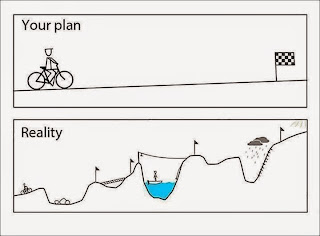
Do you get that straight line concept?  Ya, I'm sure you do.  It's pure common sense.  I hope you also noticed those hills and dales Bedros drew up and down along the line, as he suggested the potential for a lot of things that can drag you (or me) off course.  

In fact, that whole discussion should remind you of an earlier post of mine, that entitled "Dealing with Bumps in the Road".  In it, if you'll recall, there was a similar sketch, that showing a straight, upward forward line and a whole bunch of those bumps in the road...

http://my-hockey-diary.blogspot.com/2014/11/dealing-with-bumps-in-road.html

As I was listening to Bedros, I was reminded of some experiences from when I was an older teen -- 19, I think.  I was playing semi-pro football at the time, and I'd struggled for my last few years of high school attempting to put on more strength and weight.  My struggles mirrored Bedros's presentation, though, as I tried this lifting program and that one, this and that diet, and every exercise you can imagine.  Yup, I was jumping around with no real direction, and going everywhere but on a straight line.  Suddenly, something struck me...  What if I settled on the best training program I knew, and just stuck with it for 90-days?  That was the promise several programs had made, ya know:  "Stick with this and you'll experience miracles in just 90-days!"  So, I picked a program -- I just trusted it for 90-days, and went from 140- to 180-pounds in that span.  Amazing it was, but it was also just a matter of staying as close to ye olde straight line as possible.
This aside...  My dad had helped me build the start of my own home gym back then, that to include a basic weight set and a safety rack (for safety, and for working out alone).  As for doing heavier and heavier lifts, I found myself spending a good part of my paycheck on extra plates every few weeks. I tell this short tale to suggest that it was far easier for me to do my lifting at home, and not have to spend an extra hour or so per day traveling to an outside gym, and waiting in line for some machine or weight station.
My strength gains were also a matter of saying, "No," too..  I mean, everyone knew that I wasn't doing anything else until my workout was finished, and that went for a girlfriend who eventually learned to be very understanding.

Actually, I'm betting that most folks who read this have had their own straight line experiences, and maybe also dealt with some distractions or bumps in the road.  It's all common sense, though -- isn't it?

So is that thing about learning to say, "No!"  As I've mentioned in a few other posts, I'm frequently asked by family and friends to do this and do that when I'm in the middle of a project, and I've only recently gotten into the habit of sticking to my guns.

Then, one last thing...  I'm going to suggest that working the straight line can even overcome some wrong moves.  In other words, I'm guessing that the strength program I chose wasn't the best one out there.  Yet sticking to it -- or maybe sticking to any strength program for the prescribed amount of time -- was going to get me some pretty good results.  And, I'm further guessing that the same goes for the route we take in business -- or doing anything else.  Sure, there have to be better ways, but perhaps sticking with something we truly believe in -- sticking with it and sticking with it -- is going to also achieve the results we want. 

Lastly, if you have kids, I wonder if this might be a good principle to share with them.  I tend to think so.

*
For some interesting reading, I recommend an article I did long ago for CoachChic.com, where I describe breaking skills (and other tasks) into small, do-able steps:  "The Best Advice I Could Ever Share"

*
Here's that full-length video I promised.  And, if you like Bedros Keuilian, you might click through to his YouTube.com channel where you can discover a lot more...

Saturday, January 3, 2015

Nature versus Nurture


Just to kick things off with a little excitement, watch as much of this video as you'd like (there's not going to be a test at the end -- LOL).  By the way, although there's a lot of hockey mentioned in this post, I'm going to suggest that parents and coaches in other sports will ultimately find it interesting...


Okay, there's ultimately going to be a reason for that video.  But for now, the above title describes a battle currently raging in many areas of sport, although I'll suggest that it would apply to just about anything we humans do -- from jobs requiring special physical skills to those that call for super-critical thinking.
In layman's terms -- or for the sake of this discussion, those on the "nature" side of this argument believe we're born to be whatever, and one can't become outstanding at anything unless blessed with the right genetic makeup.  Those on the other side of the aisle feel one can "nurture" whatever God has given him or her, and become just as successful as those who were more blessed.
Of course, I have a couple of simple, common sense thoughts from where I stand...
1) I've read plenty about potential Mensa candidates spending their lives hugging a wine bottle on Skid Row, which suggests to me that their genetic genius didn't do them a whole lot of good.  Or, could it be that there was another, stronger gene over-riding the brainy one?
2) I think about a guy like Ted Williams, who I had the privilege to watch often as a kid growing up near Boston, MA.  I also know his story, being a youngster back then who devoured the sports sections of three daily newspapers.  From my personal observations, I can tell you that he wasn't the world's most gifted "athlete".  Actually, with that tall, "Splendid Splinter" frame, he was a disaster playing left field -- the best place they could hide him in the pre-DH days, and almost comical out there, really.  Still, anyone who knows about his background knows that he "made" himself arguably the best left handed hitter of all-time.  I mean, the stories -- about him paying friends to pitch to him when a teen, how he'd be seen practicing his swing with an imaginary bat while waiting at a bus stop, or how he'd stand for hours in front of a mirror swinging a rolled up magazine to perfect his swing.  It was said that he never went to movie theaters, either, for fear it would damage his eyesight.
My over-simplifications done, I can leave the rest of it up to others and the sciences.

Actually, as I research this topic for a coming, rather high level CoachChic.com post, I notice that runners are into this more than a lot of other sportsmen.  In fact, long distance running experts go right to what is known about the Kenyans to support the "nurture" side of this issue.  Yup, the Kenyans begin running at a very early age, and they cover vast distances over a mountainous countryside as part of their daily living and their ultimate training.  The younger ones have an incentive, too, having watched those who came before them go on to better lives after winning top competitions around the world.
Those who have followed this Diary should have already gained a lot in this area, especially from my post on "A Challenge: For Life Beyond Limits".  In that entry I referenced Malcolm Gladwell, who believes it takes something like "10,000-hours" for one to reach an elite level -- at just about anything.  I also mentioned Daniel Coyle, who describes in his writings how the brain and muscles actually change with practice.  The point in both cases is that these authors (and others) believe very much in the possibility of "nurturing", and they provide lots of fodder to support their beliefs.
By the way...  How did all this come about?  It's because I happened to do a CoachChic.com post called "Puckhandling Is A Mentality! (One “Sick” Goal!)", which kinda suggests that such a "mentality" can be encouraged in young kids.  Then, whether wise or not, I made that claim over in a LinkedIn hockey forum.  And, wow...

All heck broke lose, and there have to be close to a hundred responses to my post (which is likely good for my presence in search engines, but I've taken a beating from some over there).

In some instances, I suspect folks who hear my side of things misunderstand what I'm suggesting when it comes to that "mentality" thing.  What I'm really insinuating is that a good coach can "plant seeds" with really young kids, and get them to gradually act rather creatively with a puck.  (Others here might think in terms of handling a basketball or soccer ball, catching a football, or fielding a given baseball position with some pizazz.)

Notice that I said "a good coach" can create some minor miracles.  On the other hand, perhaps some of those who don't believe me haven't ever pulled off such a thing.  (Oh, well.)

With that, let me tell you all a little something that you might get a kick out of...
.


Balloon Dribble.jpgI always carried a bag of specially made balloons that had my logo on them, and a certain expression I'll tell you about in a few secs.
When blown up, those balloons are about the size of a baseball (or a puck)
I ask young ones to toss their balloon up in the air, and then attempt to keep it aloft with their stick.  Trust me, that they have their hands full in the start, and it takes awhile for little ones to keep the balloon up for anything like a half-minute.
Still, persevering, they do get it, and some will even start to laugh and hot-dog with the balloon.
At that point, I'll show them the cartoon-like print opposite my logo, that saying, "Go nuts!"  Ya, I ultimately want them to go nuts with that balloon, and to try all sorts of tricks.
Then, as if I haven't already been rather artful in my coaching approach to this point, I usually needle some kids and make a big deal out of others.  My point:  I want them to try to outdo those around them.  And, I'll take that a step further, having kids take turns showing the others their fanciest moves.  I'll even find a youngster who is trying something different, and I'll ask him to teach it to the others.
Now, I ask you, do you think it's possible to nurture creativity in a young hockey player's puck -- or to this point -- balloon handling?  Ha.  And, you'll have to trust me that, it's only a matter of a very short time before a little guy's work with the balloon translates to his puckhandling.  Actually, some play with a golf ball or Swedish stickhandling ball makes a great intermediate step, because either of those two balls is so lively, and either will encourage kids to move their hands pretty quickly.

Okay, about that video...  Every one of the featured players in it demonstrates some creativity with the puck.  Ironically, though, I've had 8- and 9-year old students who could perform most of the same moves -- honest to God.
What that video reminds me of, though, is something I started teaching my youngest kids eons ago...
I had been studying some video of Denis Savard performing his famous spinarama one day in my studio, and something struck me.  That very fancy looking move was actually a combination of two kinda simple moves that my kids had been doing in my clinics.
So, at the rink that night, I had my youngest kids -- about Mite and Squirt/Atom ages -- practice each of the basic moves separately.  I then showed them how to put the two moves together to make it the spinarama.  And, don't you know, those little guys were eventually doing their Savard impressions, and in both directions.
So, I have to ask again...  Can a REAL coach teach creativity or not?

Still, just because I know there will be some naysayers reading this, let me share something else...  There are other steps or progressions in the drills I've mentioned above.  I mean, once kids start getting creative with a puck, they have to be given a chance to apply those in combination practice-game situations.  I'm not going to share those here.  However, know that I do have my ways, and they're as effective as the other coaching techniques I've already mentioned.

Then, two final things...

I was a baseball and football coach in my youngest years, and I can tell folks that similar creativity -- or daring -- can be encouraged in those sports.  I promise that the same can be said about soccer.  And, you might ask, why bother?  Well, it's been my experience that such play translates to confidence, or a young player feeling very, very good about himself or herself.

Lastly, I'll soon be doing a CoachChic.com post about genetics.  And, in it I'll be giving more fodder for why nurturing is the right way to think, and that it might even be wise to have athletes learn some of their sport's basic skills rather early.

Saturday, December 27, 2014

Performing Within Your Areas of Brilliance

Oh, man, did the video you'll see in awhile hit my inbox with pretty good timing -- not that I didn't know every bit of the information for a lot of years...
Now, I'm guessing it was something like 25- to 30-years ago when a meteor dropped from the heavens and bonked me off the noggin'.  I can't recall what I was doing at the time, but it's a pretty good bet that I was driving to or from some hockey commitment, and listening to an audio cassette of the motivational kind.  (Ya, I know I'm dating myself there, but I even had an 8-track player in one of my cars way back when.)

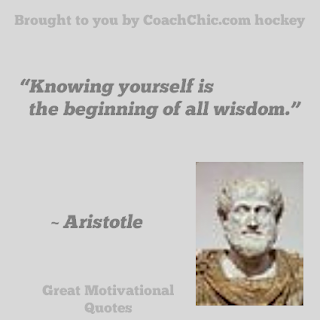
Anyway, what struck me was a revelation not unlike the one quoted by Aristotle in the accompanying graphic.  I mean, I suddenly came to the realization that I was very good at some things, and not so good at others.
This aside...  I honestly believe that all of us could be capable at just about anything.  So, I'm not saying I can't be a fair to middling bookkeeper, a fair carpenter, or get by as an auto mechanic.  What I am saying is that those things have not interested me beyond necessity, so I'd probably be wasting my time in attempts to master any of them.  (OR, I'd have to give up some of the things I'm extra-strong at in order to tackle something like one or more of them.)
Truly, though, I would probably not have a chance at being a world class performer in any of those professions.  No, I can't imagine myself reading into the night about numbers or wood joints or muffler systems, while I certainly could get lost in studying hockey teaching principles, the sciences involved in my sport, and the many other related topics.
I'm laughing to myself right now, recalling that I've told friends over the years to, "Just keep me supplied in coffee or diet soda -- with an occasional sandwich, and I'll get lost in my video work forever."
Okay, so the promised video...  As if it doesn't show that I usually practice what I preach, I follow this guy, Bedros Keuilian, who is a top fitness trainer out on the west coast.  I pay attention to what he says about training, of course, but I also keep up with his advice on running a sports related business.

More specifically, I like that Bedros is pretty good at offering advice for living the job of coaching or training, which brings me to the video that came in on Christmas Eve.  He dubbed it "How To Live Awesome", but I've kinda renamed it here, as "Performing Within Your Areas of Brilliance".  With that, please have a watch (or listen), before I add more...


If there's anything Bedros missed, it's the stuff I added up above.  In other words, before one can operate within his or her areas of brilliance, he or she has to know what those areas are -- as well as the areas that are not his or her cup of tea.

Then, before I get into my own pet peeve/s (as if you didn't know that was coming), take a look at my second graphic...
Ya, Einstein is offering some advice that's not only good for you and me -- for our work, but it's also useful for the way we deal with our kids (or young hockey players). 
As for the kids...  Imagine what we do to them when we ask the impossible.  Talk about setting them up to fail.
It's quite the same for you and me, though, when we expect ourselves to perform well at stuff we're just not cut out to do.  And, to carry that a step further, I think it's unfair of others to push us too hard towards things that just aren't up our alley.
With that, I consider myself a relative expert at a number of things, and probably in many more areas than others.  That came from first caring about a given topic, and then from totally submerging myself in it.  To me, though, it wasn't as difficult as it may sound.  For, as I've suggested a couple of times earlier, I was loving it, and it didn't even seem like work at all (ya, just keep that coffer or diet soda coming).
Yet another aside...  My dad was a pretty wise man, and his advice to his three sons never failed them.  For, when he was asked what we might do for work, he offered the same to each of us...  "Do what you love," he suggested, "and the rest will take care of itself."
Anyone who knows me well probably has seen me loving my work on the ice, or doing related things.  Baby brother has been a professional entertainer over the past 20-years around Orlando, mainly at venues within Walt Disney World and Universal Studios.  And, the brother we sadly lost just recently created inventions used by video people around the world, and at some of Hollywood's top movie studios.
Yup, do what you love, and the rest will take care of itself.
Why is that last statement so?  I think it's because one can only totally submerge himself or herself into something if there's real enjoyment involved.  Again, I was never going to be a great carpenter, if it wasn't what I thought about, day and night.

Now, all of the above isn't to say that we're off the hook in needing to do some things we don't like doing.  Out of necessity, I've had to make myself at least fairly well versed in Internet work, social media, optimizing my websites for search engines, doing the technical side of the stuff involved in my video work -- or converting it for access online, knowing the general nuts and bolts of running an online store, and actually a whole lot more.

Does that make your head spin -- that I have to do those things, above and beyond being a relative expert at hockey training?  Well, sometimes it strikes me that way, too.

Okay, as for my pet peeve/s...  I doubt the folks who drive me crazy understand any of the above.  And, in a way, I can't blame them for that.  It's not exactly the kind of stuff most people think about.

Truth be known, though, what can sometimes ruin my day is someone suggesting that something from their area of expertise is easy.  Ya, no kidding it's easy.  That's because THAT'S what they think about both day and night.  It's not, however, what I normally think about, and I could get lost pretty quickly if I even try.  Worse yet, trying usually costs me hours of work, if not days -- on the things I really should be doing.

I've gotten it from all sides, too, and more often from someone close to me, or from someone who should actually know better.  I'm mainly talking about family here, too -- and sometimes an old friend, telling me, "Gee, Dennis, you should just ______..."

Ya, "just..."  And, not wanting to be rude -- and tell them to leave me alone, I often head off at least trying to do something that I know in my heart is over my head, and something I know is goring to rob me of valuable time that should be spent elsewhere.

As I reflect back on some of those experiences, there were at least a few times when I suspected someone was trying to set me up to fail -- you know, trying to see if this old fish could climb a tree.  Did they succeed?  Hmmmmmm...  Most times I did fail -- and the chore just never got done.  At the same time, my ego has never suffered, because I've always accepted what I am and am not good at, without taking the latter personally.
Something kind of ironic...  I think one tendency that makes me a pretty good teacher is that I try not to talk over customers' heads, or snow them with too much technical stuff.  In fact, having had to learn a lot of Latin and other fancy terminology in my Phys Ed Degree studies, I've never used a single big word when addressing parents or players.  To the contrary, I've usually tried to reduce the complicated to very simple terms -- that's what a teacher does.  No, it's never made sense for me to cause anyone to feel stupid, just because they don't know what I do.
With that, my real point to this entry -- beyond getting something off my chest, is to suggest that we all need to eventually gain an understanding of what we're really good at.  And, to kinda twist my dad's words a little, I might suggest that, "Doing what you love is going to help you be successful, while doing too much of what you're not good at is likely to be your undoing."

As for me, I have to find a way to not let anyone drag me off course.  Sure, advice is good, and I know that most of it comes with some love.  At the same time, I have to let family and friends know that they are sometimes nearly killing me, or at least taking me away from any areas of brilliance I might have.

Lastly, if you like Bedros Keuilian's approach to things, visit his YouTube Channel for a lot more pretty good advice.

Thursday, December 11, 2014

Does Your Kid Deserve More Playing-time?

Oh, boy, I guess I know how to pick controversial topics...


Yup, that's the title of an online article I stumbled upon recently. And, while I might not agree in total with what the authored said, I've viewed older hockey players in his way through most of my 40-years in coaching. But, why don't I let the author of that piece, Bill Speros, tell his side of the story, first...
"One question every coach from Pop Warner and Youth Volleyball, on up through the highest levels high school competition in Texas, has heard in their coaching career is this:
'Why isn’t my kid playing?'
This topic came up in the wake of a column that ran in the Boston Globe last week about the lack of play for some in youth sports. The absurdity of many 'win-at-all-cost' coaches in youth sports is neatly matched by the fanaticism of 'play-my-kid-or-else' parents at the high-school level."

Ya, that debate does go 'round and 'round in youth sport circles. To me, seeing a LinkedIn hockey forum post suggesting either side of those issues strikes me like the sound of fingernails scraping down a chalkboard.

Thankfully, Speros makes a distinction between the earlier described youth sports and the slightly higher, more competitive levels...
'They’re just not good enough.'
'He/she just isn't fast enough.'

'He/she just isn’t strong enough.'

'He/she just isn’t tall enough.'

'He/she is too fat/too skinny.'

'He/she just didn’t try hard enough in practice.'

'He/she should not play over Jimmy/Jenny because they're faster, quicker, stronger, taller, and/or try harder.'”
Aaaaaaah, do any of those sound familiar?  If so, I'll have some advice for you at the end of this article.  Of course, as Speros suggests, "Good coaches, however, are not usually that blunt or honest."

No, I'll suggest that most coaches -- and especially the smart ones -- are probably a lot more tactful.  Are they hurting the coach/parent communication process by pulling punches, though?  My thinking is that it's entirely possible.  I mean, is there a better way to say that a kid isn't good enough?  If there is, I'll offer an idea to my fellow coaches by suggesting, "Your kid isn't one of the better ones RIGHT NOW."  And, by the "RIGHT NOW", I'm telling a parent that there is hope, and that his or her youngster just might pass some of the others -- with some time, with some work, with some whatever.

Moving on to Speros' thoughts...
"Parents get a little nutty at times when it comes to their children and youth/high school sports. Nearly every parent ever [this one included], at one time or another in the dark recesses of their minds, fancies a scenario where their son or daughter can master this or that sport well enough to earn a free-ride to college. When that dream/delusion is squashed after meeting the reality of genetics, talent, and/or interest, it’s hard to reconcile."

I'd like to say that I've never been one of "those parents", but I have.  Thank God I ultimately grew up, and I also eventually learned not to let my emotions be fueled by others (think about this one, folks).   

Speros goes on to rightfully so suggest that parents see things a lot differently -- and maybe a lot less realistically than their own kids...
"The thing is that many kids know what they’re good at, and what they’re not good at. When it comes to football, for instance, most of the middle-schoolers or freshman already know the one or two kids who are good enough to play on the varsity team. And be the ones likely to catch the eye of a college recruiter. Their parents do not."

Now, those who have followed my writings know that I see some other values to amateur sports, beyond the chance to compete and maybe excel.  Others will define that extra benefit as "learning helpful life's lessons", but then those same folks seem to retreat and look to protect the kids from doing just that.

With that, let's hear more of what Speros has to say...
"Participating in high school sports, for instance, is no different than any other education experience. You learn about winning and losing. You learn about bad calls and bad breaks. And some kids just aren't good enough to play, at least on a routine basis."

Then, here's something all of us parents need to keep in mind, especially if our kids have been given trophies and such, just for dawgone showing up...
"Far too many children today are living in a world where they never learn 'no.'  They don’t know how to handle disappointment and failure. Nor do they know how to react and move on when they don’t get their own way.  Interacting with actual people, and not just the screens on their iPhones or iPads, is a challenge, if not an impossibility.  I won’t call this 'abuse', but it’s pretty damn close."

Hmmmmmm...  I've never looked at Speros' latter suggestion, but I'm not sure I could argue with it, either.  Yup, hmmmmmm...
"This is a world constructed by 'well-meaning' but dangerously naive parents. The children know no better because this is what they’re taught.  Real-life doesn't come with 'Participation Awards', '8th-Place Trophies' or laudatory bumper-stickers telling everyone that you're able to do your job without screwing up."

I guess I said that thing about "participation trophies" earlier, and so did I comment on gaining (or not gaining) benefits from learning "life's lessons".  Then, I love it that Speros next personalizes his feelings a bit...
"It sucks when your kid isn’t playing. Been there, done that. No reasonable parent wants to see their child hurt. But no one escapes this life unhurt, emotionally if not physically.  When these kids move on in life, they are going to get rejected when they apply for college, turned down when they ask out someone for a date, fail to get the job they want, the shift they want at work, and taste failure and disappointment on multiple fronts."
The author and I are obviously on the same page with all of this, and I'll also go along with his recommendations for coaches...
"Legitimate safety concerns aside, coaches should try to make sure everyone gets some playing time. But that should never come at expense of other kids who are more talented, try harder or spend more time practicing." 

Then, as I've already mentioned, Speros finishes...
"There is, however, much on the upside to playing team high school sports that barely gets mentioned nowadays.
In that sense, sports is a true metaphor for life. No one is guaranteed 'playing' time in life. For the most part, hard work, effort, planning and desire is rewarded. The benefits can be wonderful. But it’s good to (be) prepared when it doesn’t work out that way."
Okay, now for some advice I'm forever sharing with my CoachChic.com members, as well as some articles that should further help anyone feeling he or she could use more ideas in this area...

Number one on my list of suggested reading is something I penned not long ago asking, "Are Bad Coaches Good For Players?"  My feeling is that they kinda are, if only to give our kids the chance to experience them, and add to their practice at the so-called life's lessons, at a time when those lessons are not so critical.

Here's something else I really want to share with my readers, though, because it's something I ultimately took on in my own sports parenting, and it's something I believe will help anyone who truly wants to make a difference.  And, that's to take on an approach with your youngster whereby a tryout fate or his or her playing time isn't left to chance.

I'm not saying that a kid should be pushed towards something he or she doesn't want.  However, I think there's another life's lesson to be learned if we ask our youngster, "Does this really mean anything to you?"  And, if it appears it is important to him or her, I'll suggest that the parent go about finding ways to help that younger gradually overcome his or her shortcomings -- again, ultimately to the point where nothing is left to chance or luck.  The fact is, you don't have to be the biggest, the strongest, the fastest or whatever; you just have to be good.  Then, for a bit of advice in this area, I'll recommend parents read "Where Real Players Get Real Help".

PS:  Use the link up top to Bill Speros' article in its entirety.  I think you'll enjoy that.  And, hey, he must know his stuff, 'cause he's also a former Bay State native.

Wednesday, December 3, 2014

Every Youth Organization Should Have One of These

This piece is actually a spinoff from an article I wrote for CoachChic.com, that explaining my little training center back in Massachusetts.  That place I dubbed The MOTION Lab.  And, while I might be talking here from a hockey perspective, I hope those involved in other youth sports can see how easy it would be to adapt my ideas to their local organization. 

I'd eventually shared the concept of my Lab with guys and gals in a LinkedIn hockey group, suggesting that every youth organization could build their own, to one degree or another.

If you can picture it, every team could supplement their usually-limited ice-time with plenty of off-ice training.  And, while some might be thinking about pushing older players with strenuous kinds of stuff, I'll suggest that little ones would benefit greatly from all sorts of athletic movements, and lots of things like stickhandling, shooting, passing and so forth.

Okay, so what happens in that LinkedIn stream?  A guy I talk with regularly there, Mike M, took off on the Lab idea, in a way that got me thinking about something very related.

What suddenly came back to me was an idea I'd suggested to a youth program back home.  Well, here ya go... I'd suggested to that organization that they could set up their own video and textbook library.

You're not buying my idea?  If that's so, I know why...

It was quite a few years ago when I suggested their coaching director amass that library to be filled with -- get this:  hardcopy books and VHS tapes.  LOL...  A lot has changed since then, huh?

Does that shoot down my idea, though?  Far from it.  In fact, I'd say that the advent of the Internet and digital materials makes such a venture all the easier, and a whole lot easier to house.  I mean, no real storage would be needed to offer a library full of "ebooks" and digital videos.  Yup, the whole thing could basically be "virtual"

Oh, I know...  I know...  Some guy fresh out of law school is going to tell me that there would be some legal issues involved in sharing a copyright protected book or video.  However, that's why your parents didn't send you to a Phys Ed college like mine, but instead paved your way through one that would teach you how to work around these kinds of challenges.

Needling aside, I think the right guy or gal could put something together to really educate or help member coaches, parents and players.  I'm talking about a really bright person needing to be in charge of this project, though, because two things seem to jump out at me right off the back...

First, he or she has to know the difference between good content and junk.  Ya, there's a lot of the latter out there, that's as likely to lead folks down the wrong path.  At the same time, there is some great stuff, too, that needs to be identified and acquired.

Secondly, I'm thinking that the person who oversees such a project has to be a pretty decent salesperson.  I mean, a huge collection of books and videos don't educate anyone, IF the books don't get opened and the videos aren't watched.

Man, I'm getting psyched thinking about this but, that's just me...

One more thing here...  Although everyone should be able to improve their game with lots of resources available, I'm thinking that an entire organization should improve -- probably in leaps and bounds -- as its coaches become more and more knowledgeable.  Think about that, huh?

Aaaah, but...  Back to reality.  I mean, the real fact of this matter is that a ton of organizations from around the entire hockey playing world will read this piece.  Only a handful of those will consider my idea.  Then, only a small percentage of those will be willing to put in the effort required to pull off something special.

I'm okay with that, however, because that's exactly the way things work -- in the hockey world, in the business world, and in real life.  Some folks "go for it", and some don't.  Some will "make it", and some won't.

I'm just sayin', I guess...  The MOTION Lab was one awesome idea, and so is a program-wide library or resource center.    

Friday, November 28, 2014

A Little of This and That


Frankly, I'm dealing with the aftermath of Thanksgiving today.  Ugh...  

http://my-hockey-diary.blogspot.com/2014/11/memories-of-back-home-in-tiny-whitman.html
Everything was so awesome at my sister's house yesterday -- from the chance to visit with family and friends I hadn't seen in ages, and also the chance to kinda pig-out on some of the best dishes I've tasted in awhile.  Of course, the latter is the reason I'm likely paying a price today, and it's also why I'm a little slow with the typing.  (Did I say "Ugh" yet?)

Anyway, trying to go a little easy on this old coach's brain for awhile, I thought I'd just briefly touch upon a few things readers might not know.
*
A lot of years ago I had a pretty popular online "radio show" going on from my studio back in Whitman, MA.  (That studio, by the way, is one anyone would likely die for.  I'm talking about 6 PCs -- for audio, video, special effects and lots more.  The programs running on those machines were also professional level, so I could do Hollywood-type stuff.)  Since moving to Florida, though, all of that equipment has been in storage.

Am I itching to get that and my hockey library set up once again?  Of course.  However, that's going to have to wait until Brenda and I get the extra space to dedicate a good sized room just for my work.

http://myhockeypodcast.blogspot.com/Still, a little hardship has never stopped me.  Naw...  I've managed to construct a mini-studio between two laptops I've kept with me, and I've also managed to build a new website to be home to the Hockey Secrets Podcasts.

I'm sure hockey folks will gain a lot from listening in, while other friends might get a kick out of hearing me speak in "Boston-ese".  :)
*
If you're a high level hockey skills instructor -- or involved in a slightly related area of expertise, I think you're going to want to get involved with something I have on the drawingboard right now.  Like any other idea like I'm planning, however, I can't say much more until it's launched.  If you want to drop me a note expressing interest in becoming involved, please use the short form on Contact Dennis up above.  I promise you're going to love it.  (And, hey, this is going to be one of those "be there or be square" things!)
*
https://www.facebook.com/GreatMotivationalQuotes650/Ever since I began coaching, I've been an incessant reader of all things motivational.  I mean, I've read the life stories and strategies of top coaches -- in all sports, as well as devouring everything having to do with top military, business and political leaders.

With that, a few weeks ago I developed a Facebook page solely for Great Motivational Quotes, and it's now nearing close to 100 inspirational sayings already.

And, while coaches and businesspeople usually like to borrow such quotes, I suspect others might find a favorite there to use as their own, personal motto.  (I know I have a couple, and they're included on that page.)  A number of friends have also left their favorite quotes for us to appreciate.
*
Okay, don't laugh...  I have been told for ages that I should get on Pinterest.  I sat on that -- or ho-hummed it -- for a year or so, but finally decided recently to give it a go.  Hmmmmmmm...

http://www.pinterest.com/dac650/
Actually, I kinda like it, although I've taken a slightly different approach than most...  What I've done is arrange my area something like a scrapbook.  Ya, I have an area about my earliest years, another for the slightly later years, another for what I'm doing today, and even one for my dreams for the future.

I've gotten the hang of posting -- pics to videos, but I'm still trying to get the hang of following folks and borrowing pins.  If you stop by and connect with me, though, I'm sure I'll be able to reciprocate.
*
I'm rather surprised that the two most popular posts here have both been hockey oriented, as in:  "A Father's Letter To His Son At The End Of His Junior Hockey Career" and "Are People Really THIS Dumb?"
*
Of course, it goes without saying that most of my time is dedicated to developing the CoachChic.com website -- that aimed at helping hockey players, coaches and parents beyond what I can do elsewhere.  As a matter of fact, I'm off to post my suggested "weekend reading" there, as well as updating an area I call "My Best Posts".
*
All that said, I have an awesome post that's nearly ready for release this coming Sunday or Monday.  But, I'm staying away from that -- and sharp objects -- at least for the rest of this day.

Thursday, November 20, 2014

Just How Much Homework Is Enough?

Ugh (I say that a lot here, don't I)...  

That title -- or the article I borrowed it from -- certainly conjured up some long ago memories.  Darn, but I can still see my grandson slumped over his paperwork at the kitchen counter, his shoulders shaking, and tears running down his cheeks.  I'm talking about a 6-year old here, and already a pretty dedicated little guy who always aimed to please (and who was destined to go on to gain his MBA).  He wasn't being pushed by us, either.

Anyway, the current theme stems from an article I stumbled upon in the Bridgewater State University alum area on LinkedIn.  "How Much Homework Is Too Much?" was authored by Thomas Bresnahan, an Assistant Principal in the Millbury (MA) Public Schools system. 

Now, to begin, Bresnahan seems as though he'd have sympathized with the way I felt watching my grandson that night (although he might not agree with my thoughts to strangle a teacher).  So, at least for awhile, he supported by premise with, "There have been several studies on the efficacy of homework and most state that at younger ages, homework does not show a definite correlation between the homework and improved test scores or improved academic achievement..."  My words:  "Thank blankin' God!"

From there, though, I'll suggest that Bresnahan starts brownie-ing up to his fellow educators, offering that, "The positive aspects of homework are it can help students learn responsibility, practice skills learned in class to help maximize learning, students learn to use more resources like reference materials, the internet, and libraries. Homework can also help students become more independent when they work on assignments on their own. Parents can become more involved in their child’s education by helping them with homework assignments and also seeing what they are learning in school. These are some of the positive aspects of homework." 

Hmmmmmmm...  I don't think there's a parent (or even a student) on earth who would disagree with a single one of those benefits.  Not a one. 

He goes on to explain that he's changed his point of view with time "...as a result of looking at relevant data and the proverbial 'Big Picture.'”

Bresnahan then cites one of my all-time favorite groups... Ya, "The NEA (National Education Association) created some recommendations for assigning homework. It basically stated that a student should receive no more than 10 minutes of homework per grade level a night."  Well, if you missed something in there and felt good for a sec, it might have been the part about "per grade level".  For, he goes on to give as an example, "... an eighth grader would have no more than 80 minutes assigned in a night."  (Before ending this segment, let me tell readers that I was joking about the NEA being one of my favorite groups.  In reality, I think their purpose is more as a Political Action Group -- and justifiers of all things related to public education in the US -- than one concerned about the education of our kids.)

Now, although not every student engages in after-school, extracurricular activities, a good many do.  And, I'm guessing that more of those who are thinking about college do than don't.  What I'm getting at is that something like five junior high or high school courses -- times 80 minutes -- just about prevents a kid from having a life, not to mention the proper amount of sleep. 

Thankfully, though, Bresnahan seems to come back to his senses with I paragraph I feel compelled to paste in here almost in total...  "What is the negative impact of too much homework? I believe students need to go outside and play, be active, and socialize with their friends and family. Excessive homework can stunt a student’s growth in these areas. We want students to develop in many different areas not just in rote memorization. Also, is the homework equitable? What if several students don’t have the support at home to help with their homework while others do? Will this homework be graded? A family of well-educated parents certainly have an edge over those without, but all students are held accountable for the same graded homework. Something to think about! Should the majority of homework assignments even be graded or is it more about the effort in the process of completing it? If a student doesn’t understand the homework, won’t they just be performing the same imperfect tasks over and over which can be detrimental? Wouldn’t it be beneficial for the homework assignment to be based on areas that need work from class that a teacher noticed during some kind of formative assessment? What if the teacher also provided a link on their web page to help them work through the problems, material, or skills? Just a thought!"

No, Mr Bresnahan, that's more than just a thought.  In fact, it's pretty much my belief, and I'm guessing it's also pretty close to what most of my readers believe.

Unfortunately, that article left me wanting for more.  I mean, I don't think Bresnahan did any more than state both sides of the problem.  Oh, I won't totally fault him, because he's at least raised a more than worthy subject.  It's just, I guess, that he never did seem to land on either side of the issue.

I'm a hard bitten old hockey coach, though, and I've gotten to the point where I dare to speak my mind (so long as Brenda first checks my daily mail for firebombs).

Before going on to my idea, let me suggest one other benefit I see in homework.  Just pardon me for relating it to hockey, as well as to my Phys Ed & Coaching training, and especially to my favorite college course, the Principles of Motor Learning".  For, that's where I discovered a number of valuable teaching methods, including the Theory of Mass versus Distributed Training.  In that one, it's suggested that doing a given form of training for short bouts can be extremely effective, as those short bouts add up over time.  Think something like the hockey slapshot here, where it might be better to give players a break just before they become bored with that drilling, and then bringing them back to it when they're (mentally) refreshed and more receptive to further learning.  In many instances, that might suggest that I use a specific drill for 8-minutes tonight, for another 8-minutes at the next practice, and so on.  I usually take that a step further, though, by having my kids work on something like their slapshot for 3- or 4-minutes, call them in for some sort of tip or demo, send them back out to practice for another short bout, and then repeat the shooting one more time.  Going back to homework, then, consider that reviewing what students learned in the day's classrooms likely gets reinforced with some later short bouts of study.

With all that, here's a thought on homework...  In all honesty, I don't think it would take too much studying to arrive at a maximal time FOR ALL NIGHTLY HOMEWORK, taking into consideration all the negative things Mr Bresnahan noted about.  In other words, seriously consider the things a kid needs in order to eat right, sleep lots, and in general have a life.

Arriving at such a limit on homeward, I'd next suggest that each school course be given certain nights to assign an estimated x-minutes for their assignments.  In other words, maybe the math department can assign and an estimated 20-minutes of work on four nights per week, and 40-minutes on one night.  The English department would be on a different schedule, the Science department on another, etc.  Said yet another way, only one department would have Mondays for their long assignments, another would have Tuesday nights, and each of the other nights could be assigned to the other departments.  If you think about it, even that amounts to a lot of nighttime work for a student carrying a normal workload.  But it would conform to the idea of Distributed Training, and also include a touch of sanity. 

PS:  Over time, I've written a couple of articles on growth spurts in hockey players:  "Growth Spurts in Hockey Players" and "The Effects of Growth Spurts on Hockey Players".  One of those included a poll, asking if parents noticed their kids growing more during the summer months than during the school year.  Are you thinking there's a correlation here?  I surely do.  For one thing, kids get to sleep in more often during the summer; for another, I think most of them are also subjected to less stress during that period.

PPS:  One of the most popular posts within this Diary is also an entertaining one entitled "Do schools kill creativity?"  (I tend to believe so.)

Your thoughts on all this?  I'd love to hear them down below.

Monday, November 17, 2014

Are People Really THIS Dumb?

This being only a few weeks after the polls closed for midterm elections in the United States, I'm wondering how many readers are glad to see all the political ads gone.  Ugh.  I had to endure them from my newer home in Florida for a time, and then had to return to my old home in Massachusetts to experience even more.  The airways in both states were filled with those ads -- or should I say polluted, with most of them being pretty questionable in integrity.

In trying to be honest here, I felt that candidates from both major political parties were lying, or at least stretching the truth quite a bit.  And, while I lean towards the Conservatives in my later life, I am admitting that most of them could use some truth serum, too.

Anyway, while you might be spared for a couple of years, I and my hockey friends evidently can't escape more political ads.

What I'm talking about is a YouTube.com video that keeps getting recycled and recycled, with no relief in sight.

Actually, if one would check the comments listed below that video, he or she would discover that most hockey folks don't like its message.  At the same time, there's always someone seemingly swayed the other way by it, which has them posting it to one social media site or another.  (Did I say "Ugh" yet?)

With that, I'm going to show my readers that video, and then provide my own feelings right after.  Or, as the late Paul Harvey always said, I'll later tell you "the rest of that story"... 


Okay, here's the politics of that video...

America's governing body, USA Hockey, produced the video, mainly trying to promote their belief that little ones are better off playing on a smaller, scaled down ice surface.

If there's an initial thing rotten in Denmark, though, it's that USA Hockey has already forced that idea on its membership.  In other words, their youngest members are going to play on the smaller surface, whether anyone -- including member parents, coaches and administrators -- like it or not.  So, this being after-the-fact, all I can guess is that USA Hockey is trying to do damage control, or maybe continue to influence members that they're doing the right thing.

Now, as an aside here, my Minor Degree studies were in Instructional Media, which included a number of Radio & TV Production courses.  That was on purpose, because I planned to combine my Physical Education & Coaching Major with those skills to do a lot with video, including producing my own instructional videos (the analogue-type back through the 1980's, and digital versions for the years thereafter).  I say this because I know all the tricks when it comes to things like talent selection, scripting, and clever editing.  Ya, I know that stuff...
     
  • As for the talent selection, I'm hoping no one is dumb enough to believe that the group of players in that video just happened to be skating on a local pond when the camera crew arrived.  Geeeeeeeze...  They were handpicked.  Actually, I haven't been able to get an answer about whether they were either compensated or at least members of USA Hockey.  (Oh, someone might want to shoot my accusations down, just because I could be wrong on the latter.  But being wrong about that one point doesn't in any way negate everything I'll have to say here.)
  • Then, the scripting...  Give me a dawgone break.  The guys in that video may not have been given word-for-word scripts, but I can assure you there weren't going to be any anti-USA Hockey comments saved to tape.  As a matter of fact, if you go watch that video again, after hearing me out, perhaps you'll get the same sense as I, in that the commentary is as phoney as it can get. 
  • Lastly, no matter what took place on the day of the shoot, I can tell you that absolute miracles can be achieved in the studio.  In other words, if the idea of the final video was to give all the right testimony for forcing little ones onto smaller ice surfaces, that could be accomplished in the final edit.

Why do I go to such lengths here -- about the talent, the scripting, and the editing?  It's to liken that video to exactly what we've spent months viewing in those political ads.  Pure propaganda, I mean, with as much truth in that video as there was in either the MA or FL governor's races.

Non-hockey readers might like to know that I'm not going to go off too much about the hockey part of this, because that's not the idea behind my Diary.  So, while I could provide plenty of reasons why USA Hockey might rethink things -- from a learning-the-game standpoint, I'll only suggest here that most of their members don't like the idea.  Of course, this isn't the first time they've crammed unpopular rule changes down their members' throats -- since the body-checking issue is still fresh in my mind.

Lastly, though, I still have to ask my title question, wondering "are people really THAT dumb" -- to believe that video, and to keep posting it to their Facebook walls or elsewhere?  The answer, I guess, is "evidently so".